Glaciers: Frozen Archives of History

In 2017, a couple dressed in World War II–era clothing was found in a crevice of the Les Diablerets glacier in southwestern Switzerland. Their daughter, who had spent her life searching for them, was finally able to hold a funeral for her parents, whose bodies had been perfectly preserved in the ice. The following year, in 2018, a global heatwave caused even the Alpine glaciers to melt, revealing the wreckage of a U.S. Dakota military aircraft that had been hidden for more than half a century.
Glaciers preserve the past exactly as it was, even decades ago, and act like a time capsule that can take us back thousands or even tens of thousands of years.
From Snowflakes to Frozen Giants
When we think of glaciers, we often imagine the vast icy stretches of the polar regions. These are known as continental glaciers. But glaciers are simply enormous masses of compacted snow and ice that build up over long periods of time, and they come in other forms as well—such as alpine glaciers that wind through mountain valleys like those in the Alps.
Continental glaciers include ice sheets and ice shelves. Ice sheets sit on land, while ice shelves extend over the ocean. When pieces break off an ice shelf and fall into the sea, they become icebergs—only about one-seventh of which is visible above the surface. This is where we get the expression “the tip of the iceberg.”
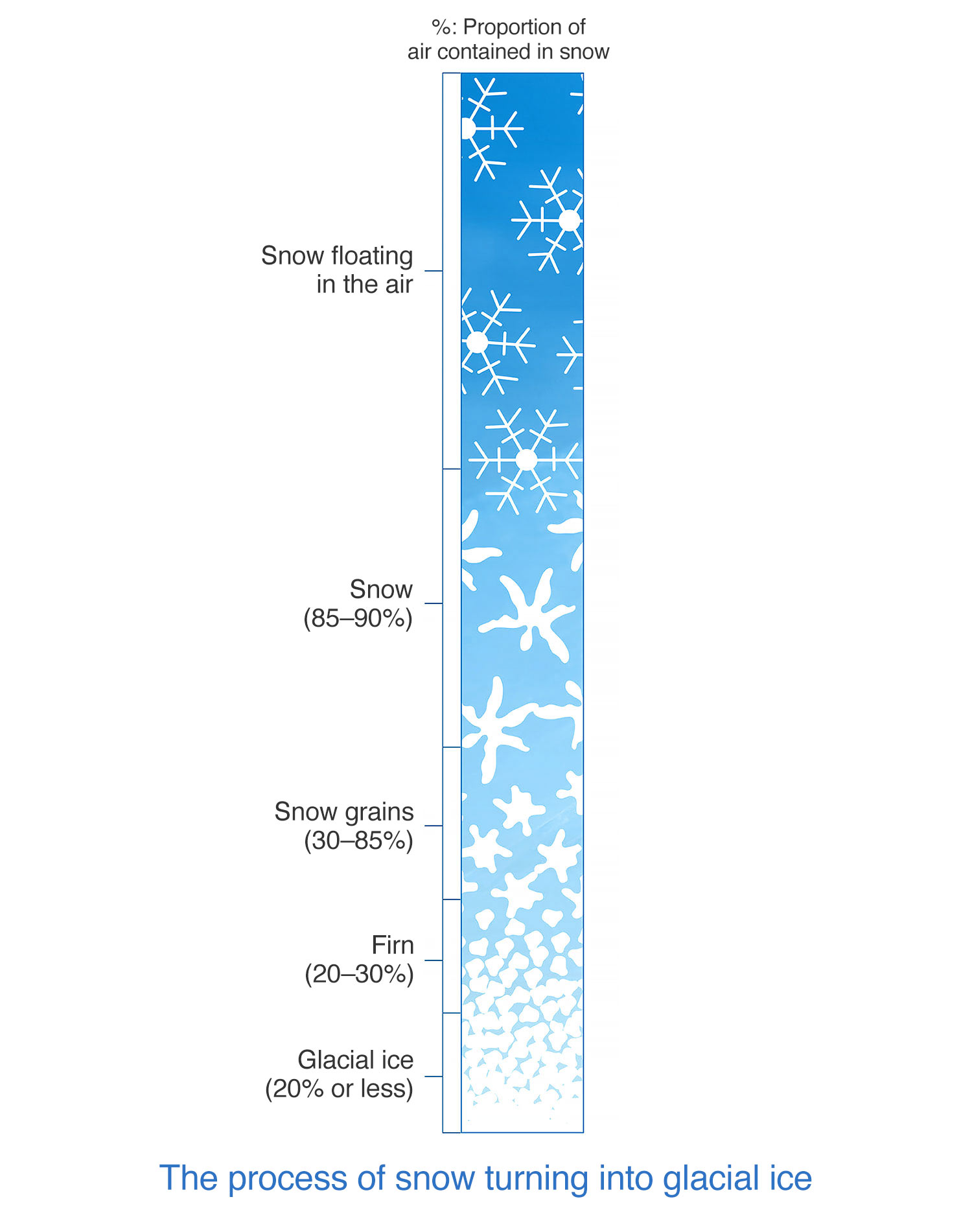
So how do glaciers form? Surprisingly, they all begin with something as small as a snowflake. Step outside on a snowy day and hear the crisp crunch beneath your feet—this is the first step in snow being packed into solid ice. Fresh snow has a density of about 0.05 grams per cubic centimeter. As layer after layer accumulates without melting, the weight compresses the snow beneath it. Air trapped between the flakes becomes increasingly squeezed out. Once the density exceeds 0.8 grams per cubic centimeter, the snow has transformed into glacial ice. Depending on conditions, this process can take anywhere from 50 years to several hundred.
Like pancake batter slowly spreading across a pan, glaciers gradually extend outward. But their growth is not unlimited. As the edges break off into the sea or flow downhill under their own weight, glaciers maintain a dynamic equilibrium in size. These ice masses are remarkably thick—Greenland’s glacier averages 2 kilometers (1.24 miles) deep, with the deepest areas exceeding 3 kilometers (1.86 miles). Built up layer upon layer over immense spans of time, glaciers now cover about 10 percent of Earth’s land surface and hold more water than anything else on the planet except the oceans.
The Moving Sculptor
Just as the ocean has its currents, glaciers move as well. Their movement is far too slow to notice with the naked eye, but glaciers can travel at very different speeds—from barely shifting at all to advancing 20 to 30 meters (65.6 to 98.4 ft)in a single day. As a glacier moves, the ice and rocks at its base move with it, gradually grinding down the land and reshaping the terrain. Glaciers not only erode the ground but also carry and deposit what they erode. This process of erosion and deposition leaves behind scratches across the landscape or creates features such as moraines,1 and over time it can dramatically transform the shape of the land.
1. Moraine: A mound of rocks deposited by a glacier as it moves downstream.
Flowing water typically carves simple V-shaped valleys, but glaciers move slowly and sculpt distinctive peaks and valleys of their own. A mountain whose sides have been eroded by glaciers, leaving a sharp, horn-like summit, is called a horn. When land sinks under the great weight of a glacier, it forms a U-shaped valley. If seawater later fills this valley, it becomes a long, narrow inlet known as a fjord.
Fjords are among the world’s most striking natural landscapes and are rarely found outside glaciated regions. Bergen, Norway—often called “the gateway to the fjords”—is famous for its dramatic scenery and even inspired the setting of the movie Frozen. In this way, glaciers act as master sculptors, creating grand works of art across the surface of the Earth.


What If Glaciers Melt Away?
On August 18, 2019, a “glacier funeral” was held in Iceland. The Okjökull glacier, which had covered the Ok volcano near Reykjavík for more than 700 years, had melted away under the pressure of global warming. Glaciologists had already declared it “dead” in 2014, and it soon became a symbol of climate loss. To honor its memory—and to warn the world about the growing climate crisis—scientists held a ceremonial funeral and installed a memorial plaque.
Many other glaciers around the world are melting at a rate far faster than their natural flow. About 70 percent of the sun’s energy that reaches Earth is absorbed by the atmosphere, land, and oceans, while the remaining 30 percent is reflected back. Not all surfaces reflect sunlight equally: soil reflects less light than water, and water reflects less than snow and ice. This is why snowy landscapes appear dazzling on clear days. Snow and ice in glacial regions reflect 80–90 percent of sunlight. But as glaciers shrink, this reflectivity drops, making it harder for heat in the atmosphere to escape into space. In turn, global warming intensifies, causing even more glacial melt—a dangerous feedback loop.
What would happen if all the glaciers on Earth melted? When ice melts in a cup of water, the water level barely changes. Similarly, the melting of sea ice does not significantly raise sea levels. But when ice resting on land melts and flows into the ocean—like adding ice to a glass that is already full—the water level inevitably rises.
If all of Earth’s glaciers were to melt, global sea levels would rise by more than 70 meters (230 ft). Many of the world’s major coastal cities would be submerged, and some nations could vanish entirely, drastically reshaping the map of our planet. And the consequences would not stop there. As glacial ice melts, the salinity of polar seawater decreases, altering its density and slowing ocean currents. Weakening these currents would disrupt global climate patterns, leading to extreme and unpredictable weather.
Glacial melt also affects the Earth’s crust. Beneath the hard outer layer of the crust and upper mantle lies the soft asthenosphere.2 When the immense weight of glacial ice is removed, the mantle material below begins to shift. It pushes upward, lifting the land in an effort to regain balance. This process has caused the Scandinavian Peninsula to rise approximately 350 meters (1,148 ft) since the last Ice Age—and it continues to rise even today.
2. Asthenosphere: The soft layer located several tens of kilometers beneath the lithosphere.
Though glaciers may seem distant and unrelated to everyday life, especially since most are found in remote polar regions, they have a profound influence on the environment we depend on.
Glaciers: The Tree Rings of Earth
Greenland in the Northern Hemisphere and the Antarctic continent are some of the coldest places on Earth, where average temperatures remain below freezing year-round. Yet scientists continue to travel to these harsh regions. They drill hundreds of meters into the ice or use radar to probe the depths of glaciers—areas said to be even more challenging to study than the surface of Mars. Why, then, do these frozen landscapes draw such intense scientific interest?
In 2013, a Russian research team discovered a mammoth that had lived 15,000 years ago, perfectly preserved in glacial ice. They were even able to extract soft tissue and unfrozen blood. Through these icy archives, scientists can learn about Earth’s environment from tens of thousands of years in the past. And by drilling long, cylindrical samples known as ice cores from glaciers more than 3 kilometers (1.86 miles) deep, they can uncover even older history. Ice cores reveal as much as 130,000 years of environmental records in Greenland and up to 1 million years in Antarctica.

Just as the rings of a tree reveal its age and past climate conditions, a glacier’s cross-section—from surface to bedrock—contains layers that store information like natural time rings. By analyzing the air bubbles trapped in each layer, scientists can uncover past environmental conditions, climate shifts, glacial growth periods, and the cycles of glacial and interglacial ages. Pollen preserved in the ice reveals what plants once grew in the region, while dark streaks of volcanic ash show when and where eruptions occurred and how the ash spread—allowing researchers to reconstruct even unrecorded events.
Scientists focus on ice cores because the data preserved within them helps us understand today’s environment and anticipate future climate patterns. It is as if they are journeying through time, linking the past with the present and future.
In science fiction, time machines allow people to travel freely across eras. In reality, however, creating such a machine is far beyond our current technology—it would require overcoming physical laws and dimensional barriers.
Earth’s glaciers, meanwhile, quietly record the present within their frozen layers. The air we breathe today will someday fall as snow, gradually compressed into ice layer upon layer. That snow and air will harden into solid ice, forming natural rings within glaciers—a frozen chapter in the unfolding story of our planet.
“From whose womb comes the ice? Who gives birth to the frost from the heavens when the waters become hard as stone, when the surface of the deep is frozen?” Job 38:29ᅳ30


