Star Cluster: The Community of Stars
In 1609, an astronomer made the groundbreaking discovery that the Milky Way was not a cloudy band of light but a collection of countless stars. That astronomer—who would later shape the foundations of modern physics and astronomy—was Galileo Galilei. Using telescopes he crafted and refined himself, he observed that the Milky Way is actually the side view of our galaxy as seen from Earth.

Credit: ESO/Jose Francisco Salgado
(josefrancisco.org)
More than 400 years have passed since then. Today, with advancements in astrophysics and the discovery of innumerable celestial bodies, humanity is able to look far beyond the solar system into a universe that is vast, dynamic, and seemingly infinite.
Our Address in the Universe
Just as human beings gather to form societies, stars group together as well. The most basic unit of this cosmic community is the galaxy—a massive system made up of stars, star clusters, nebulae, and dark matter. A typical galaxy contains around 200 billion stars, though the number can vary greatly: dwarf galaxies may have tens of millions, while giant galaxies can hold trillions.

Credit: ESO
Galaxies are generally classified by their shape: spiral, elliptical, or irregular. Our Milky Way is a barred spiral galaxy, distinguished by a bar-shaped structure running through its center. It is composed of a disk, a bulge1, and a halo2. Young stars are abundant along the spiral arms of the disk because the interstellar gas and dust needed to form stars are concentrated there.
1. Bulge: The swollen central region of a galaxy’s disk, densely packed with stars
2. Halo: A spherical region surrounding the disk, made up of stars and dark matter
Just a little over a century ago, people believed the Milky Way was the entire universe. But when astronomers confirmed that the Andromeda Galaxy was located outside the Milky Way, many other objects once thought to be nebulae were also revealed to be galaxies. The Milky Way turned out to be just one among countless galaxies. So what lies beyond it?
Galaxies, which are themselves vast assemblies of stars, also gather into even larger structures: galaxy groups and galaxy clusters. A small collection of dozens of galaxies is called a galaxy group, while a large gathering of hundreds or thousands of galaxies is known as a galaxy cluster. The Milky Way, together with the Andromeda Galaxy, the Triangulum Galaxy, and about 50 others, belongs to the Local Group.
But the hierarchy does not stop there. Galaxy groups and clusters join together to form superclusters. The Local Group is part of the Virgo Supercluster, which contains at least 100 galaxy groups and clusters. The Virgo Supercluster, in turn, is a component of the Laniakea Supercluster—a Hawaiian term meaning “immense heaven.”
Because of gravity, galaxies tend to gather rather than spread evenly across space. This clustering forms dense regions and vast empty voids, creating a bubble-like structure on the largest cosmic scales. Yet this structure represents only what current technology can detect—scientists believe there is far more beyond the boundaries of our observable universe.
Within the vast cosmic structure—inside the Laniakea Supercluster, the Virgo Supercluster, and the Local Group—lies the Milky Way. And somewhere on the third planet from the Sun, in a solar system about 26,000 light-years from the galaxy’s center, is where we find our address in the universe.
An Immeasurable Space, a World of Infinity
In May 2019, the Space Telescope Science Institute (STScI) released a breathtaking image created from 16 years of Hubble Space Telescope data, showcasing an astonishing 265,000 galaxies. Though the image captured an immense stretch of space, its size on the universe was no larger than the full moon as seen from Earth. This small yet extraordinary snapshot served as a striking reminder of the universe’s truly unfathomable scale.
Until recently, scientists believed the universe contained around 200 billion galaxies. But in 2016, researchers from the University of Nottingham in the United Kingdom announced that the actual number may be ten times higher. According to their findings, over 90 percent of the universe’s estimated 2 trillion galaxies are too distant or too faint to be detected, even with the most advanced telescopes. In comparison with such an enormous cosmos, humans are smaller than dust—perhaps even smaller than atoms. That is why describing stars and space using familiar units like meters is nearly impossible.
Instead, astronomers measure the universe using galaxies and light-years. A light-year is the distance that the fastest known entity—light—travels in a vacuum in one year. To put this into perspective: light moves at 300,000 kilometers (about 186,400 miles) per second, fast enough to circle the Earth seven and a half times in just one second. Multiply that speed by 60 seconds, 60 minutes, 24 hours, and 365 days, and the result is one light-year: about 9.5 trillion kilometers (about 5.9 trillion miles), the equivalent of traveling from New York to Los Angeles about 19.7 billion times or making roughly 63,000 round trips between Earth and the Sun.
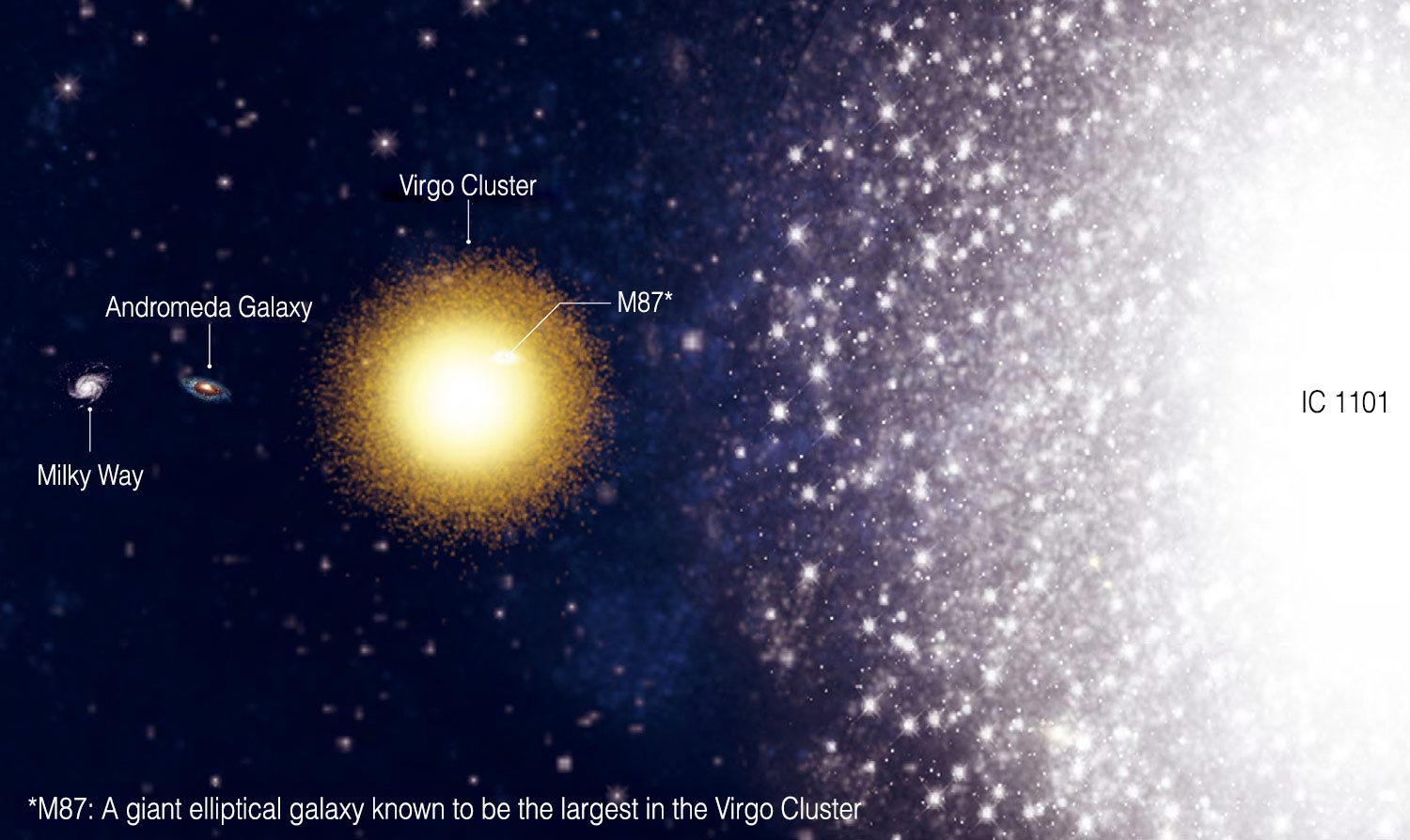
With this cosmic measuring stick, we can begin to understand the scale of our galaxy and what lies beyond. The Milky Way spans about 100,000 light-years in diameter and contains 200 to 400 billion stars. The distance between its spiral arms is about 5,000 light-years, and its average thickness is around 2,000 light-years. The Sun orbits the center of the Milky Way at a speed of 220 kilometers (about 136 miles) per second and takes 230 million years to complete a single circuit—one galactic year. Having existed for about 4.7 billion years, the Sun has completed its galactic orbit roughly 20 times. In “galactic age,” it is just twenty years old.
The largest known galaxy outside our own is IC 1101, located more than a billion light-years from Earth. It is estimated to contain over 2,000 times as many stars as the Milky Way, with a diameter between 4 million and 6 million light-years. For comparison:
• The diameter of Local Group is about 6 million light-years,
• The diameter of Virgo Cluster is about 110 million light-years, and
• The diameter of Laniakea Supercluster—home to about 100,000 galaxies including the Milky Way—is across 500 million light-years.
In contrast, the diameter of observable universe is about 94 billion light-years. This means that light would need to travel for 47 billion years from Earth to reach one edge of what we can presently observe.
Star Clusters in Motion: Meeting, Colliding, and Evolving
Just as people draw closer or create distance within social groups, shaping the course of their lives, the stars in the universe also gather in structured clusters rather than scattering randomly. Within galaxy groups, neighboring galaxies often approach and collide under the pull of gravity. When massive galaxies interact, tidal forces3 caused by differences in their gravitational fields4 can stretch and distort their shapes, sometimes reshaping the galaxies entirely.
3. Tidal Force: The difference in gravitational pull exerted on different parts of a celestial body. Tidal forces create ocean tides on Earth due to the Moon and the Sun, and during galaxy interactions, they can stretch or distort galaxies.
4. Gravitational Field: The region around a mass where its gravitational influence can be felt. Any object within this region experiences the mass’s gravitational force.

Galactic encounters take many forms. Some galaxies merely brush past each other, while others collide head-on. Smaller galaxies can be absorbed into larger ones. When galaxies pass one another, their shapes may stretch or tear into bars, rings, bridges, or long tidal tails. When two high-momentum galaxies collide, they may pass through each other with only slight distortions. And when two or more spiral galaxies merge, they can transform into an entirely new structure—a giant elliptical galaxy. Remarkably, even during these dramatic events, the stars themselves almost never collide because the distances between them are so vast.
These slow-motion cosmic dances—played out over hundreds of millions of years—are both mysterious and magnificent. Collisions can exchange clouds of gas and dust, ignite the centers of galaxies with radiant light, or trigger explosive waves of star formation. A galaxy that has stopped forming stars and contains only aging stellar remnants can be revitalized through such an encounter. The Milky Way itself grew by absorbing many dwarf galaxies—and even today, about 1% of the galaxies in the universe are still in the process of merging.
The Andromeda Galaxy lies 2.2 million light-years from the Milky Way, which, on a cosmic scale, makes it practically our neighbor. Likewise, although human beings live in different places and circumstances, we ultimately share one community—our home planet, Earth.
On this tiny world, humanity experiences countless collisions of interests, desires, and circumstances. Yet an unseen order still holds. Across the boundless universe as well, the celestial bodies that adorn the cosmos follow their own unique structure and order. Since the birth of the cosmos, the ceaseless cycles of star formation and galactic interaction have shaped the growth of galaxies, transforming the universe into a realm of ever-evolving beauty. And today, we stand within this extraordinary cosmic order, witnesses to its grandeur.
“He speaks to the sun and it does not shine; he seals off the light of the stars. He alone stretches out the heavens and treads on the waves of the sea. He is the Maker of the Bear and Orion, the Pleiades and the constellations of the south. He performs wonders that cannot be fathomed, miracles that cannot be counted.” Job 9:7ᅳ10
He determines the number of the stars and calls them each by name. Psalm 147:4


