Envoys
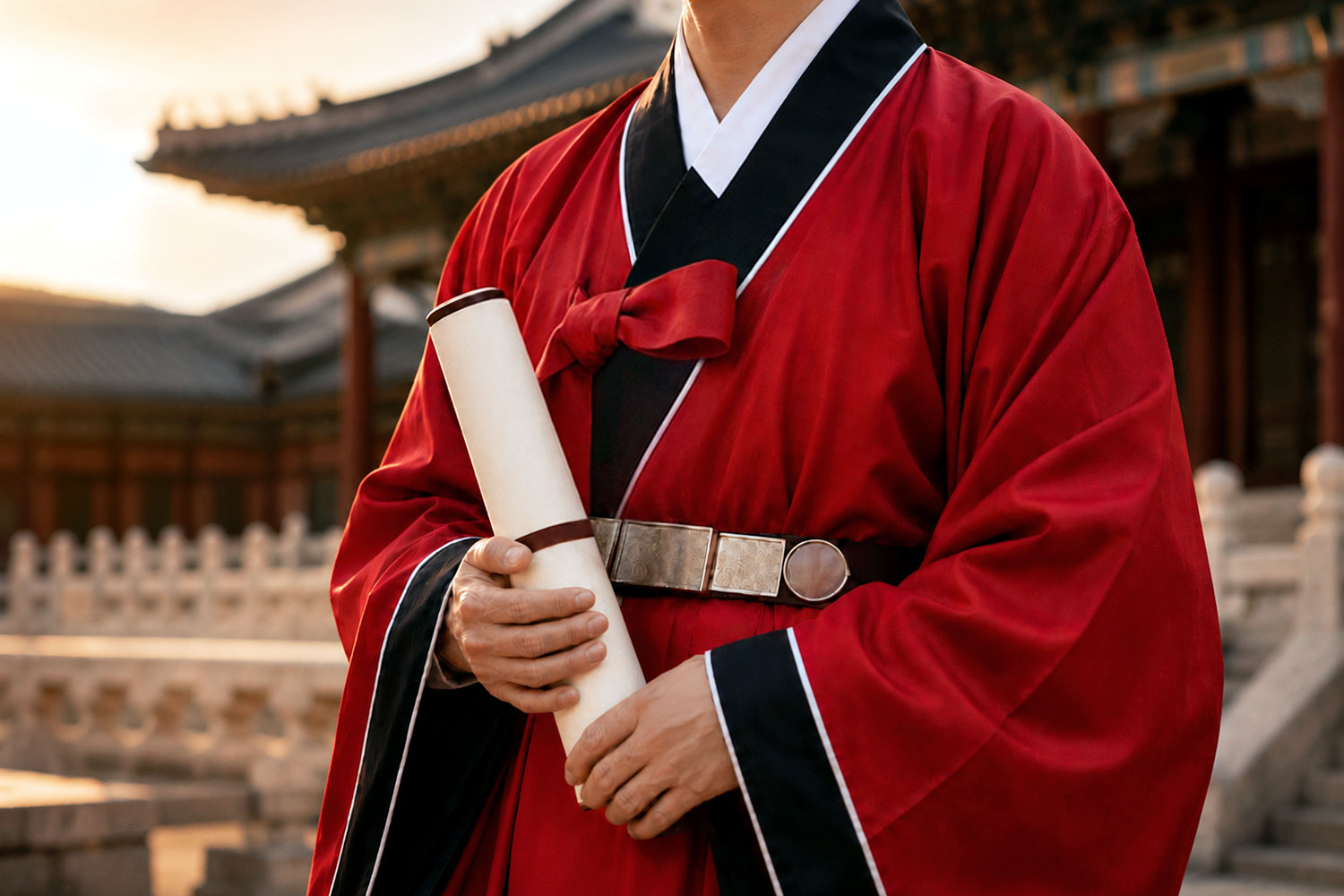
Ushimado is a small village in Setouchi, Okayama Prefecture, Japan. The strains of “Arirang,” played on the taepyeongso, fill the air as people dressed in hanbok parade through the streets. The festival commemorates the processions of Joseon diplomatic envoys that once passed through the village.
The term tongsinsa (通信使), meaning “envoys who communicate through mutual trust,” referred to the diplomatic missions sent from Joseon to Japan. Each delegation consisted of four hundred to five hundred people, and the approximately three-thousand-kilometer round trip from Hanyang (the former capital of the Joseon Dynasty and present-day Seoul) to Edo (the former name of Tokyo) took anywhere from six months to a year and a half. When the warriors assigned by Japan to escort the delegation joined the procession, it swelled to more than two thousand people. The envoys also served as cultural ambassadors. Wherever the delegation passed, crowds gathered like clouds, eager to receive writings composed by members of the mission or to watch performances of equestrian acrobatics.
At a time when contact with distant regions was far from commonplace, envoys were virtually the only channel through which a nation could convey its intentions to the outside world. The tongsinsa missions ceased after the Japanese invasions of Korea but were later resumed at Japan’s request. For nearly two hundred years, the envoys traveled between the two countries, helping to restore diplomatic relations. Because their role was so important, only people of exceptional ability were selected as envoys. They needed detailed knowledge of the language, culture, customs, and political affairs of the country to which they were sent. They were also expected to conduct themselves in a manner befitting the authority and dignity of their own nation.
Above all, they needed the courage to face dangers that might arise at any time and in any form. Although envoys were generally afforded protection, they could still face insults, persecution, and even threats to their lives. They also needed humility. Even when they received lavish treatment as representatives of the king, they had to remember that the honor belonged not to them but to the king. Most important of all, they had to fulfill their mission to convey the king’s will faithfully under every circumstance.
God has continually sent envoys—prophets and apostles—to mankind to convey His will. Through them, we have come to meet our spiritual Father and Mother and to keep God’s decrees, through which we receive the blessings of the forgiveness of sins and eternal life.
Now God has entrusted us with the special mission of going to all nations and preaching the gospel of the kingdom. At the same time, He has granted us the power of the Holy Spirit to carry out that mission. Just as the king’s will cannot be delivered unless an envoy sets out, no one can hear the truth unless someone proclaims it. As envoys sent by God, let us strive to convey fully the will of God Elohim, who desires to save mankind. Let us display God’s glory through good deeds and humility, and press onward into the wider world with courage and patience, no matter what difficulties we may face. Let us hold firmly in our hearts God’s promise: “I am with you always, to the very end of the age.”
“. . . And how can they hear without someone preaching to them? And how can anyone preach unless they are sent? As it is written: “How beautiful are the feet of those who bring good news!” Ro 10:14-15


